 Contact Us
Best Flight Compensation Services Compared (2026)

 9 min.


The best flight compensation service depends on what you need. Gyro is the fastest and easiest to start, the top pick for most travellers who want a quick, mobile-first experience. Flightright is the strongest choice if your claim has already been rejected. Compensair and MyFlyRight offer the lowest fees at around 25%. AirHelp handles the broadest range of claims with the most automation. If your case is simple and the airline has not yet responded, filing directly is free and often works just as well.
Do You Actually Need a Compensation Service?
Not always. Under [EU Regulation 261/2004] and its UK equivalent [UK261], passengers are entitled to fixed statutory compensation of €250–€600 [approximately $270–$650] per person, for delays of three hours or more, cancellations with less than 14 days’ notice, and denied boarding due to overbooking. You can file that claim yourself, directly with the airline, for free.
When to file yourself
Filing directly makes sense when the compensation amount is under €400, the airline has already acknowledged fault, the route was a straightforward point-to-point flight, and the disruption happened recently. Most airlines are legally required to respond within a set period. A clearly worded email that references EU261 or UK261 by name, states the delay duration, and specifies the statutory amount you are claiming is often enough to get a result without any third party involved.
When to use a service
A compensation service earns its fee when the airline has already rejected your claim, when multiple passengers on the same booking need to claim simultaneously, when the case is older, when the route involved a codeshare between two carriers, or when the cause of the disruption is genuinely disputed. Services have legal teams, enforcement experience, and established processes for taking airlines to court. For premium travellers, the time saved alone can justify the commission.
Note: This article provides general information only. It does not constitute legal advice. Compensation eligibility depends on your specific circumstances, and claim deadlines vary by country.
How We Compared These Services
We assessed each service on four criteria: the standard commission fee, whether litigation costs are included or charged separately, the types of claims each service handles best, and verifiable track record. Services with no independently confirmed history were excluded. Fees shown are approximate, always confirm the current structure directly on the service’s own website before submitting a claim, as rates change.
Best Flight Compensation Services at a Glance
| Service | Std. Fee | Litigation | Best For | Key Notes |
|---|---|---|---|---|
| Gyro | ~30% | Often included | Speed & ease — UK routes | AI-native; fastest intake; mobile-first; shorter track record than legacy services |
| AirHelp | ~35% | Additional fee | Full automation; past flights | Largest brand; inbox scanning; fees can reach ~50% with litigation |
| Flightright | 20–30% | Additional fee | Disputed or rejected claims | Litigation-first; aggressive enforcement; strong in DACH markets |
| Compensair | ~25% | Additional fee | Low-fee EU claims | Clean portal; efficient; smaller global footprint |
| AirAdvisor | ~30% | Additional fee | International routes | Transparent fees; strong educational content; broad global handling |
| SkyRefund | ~35% | Often included | Transparent no-win, no-fee | Strong Trustpilot rating; over 1 million claims handled |
| MyFlyRight | ~25% | Additional fee | German / DACH routes | Competitive fee; multilingual; strong regional expertise |
| ClaimFlights | ~25% | Often included | Multi-language EU claims | Good value; litigation often bundled |
| ClaimCompass | ~35% | Additional fee | Simple EU claims | Streamlined for uncomplicated cases; less suited to disputes |
| Refundmore | ~30% | Additional fee | Scandinavian routes | Specialist in SAS, Norwegian, and Nordic low-cost carriers |
Fees are approximate and subject to change. Always confirm the current fee structure on the service’s own website before submitting a claim.
1. Gyro: Best for Speed and Ease
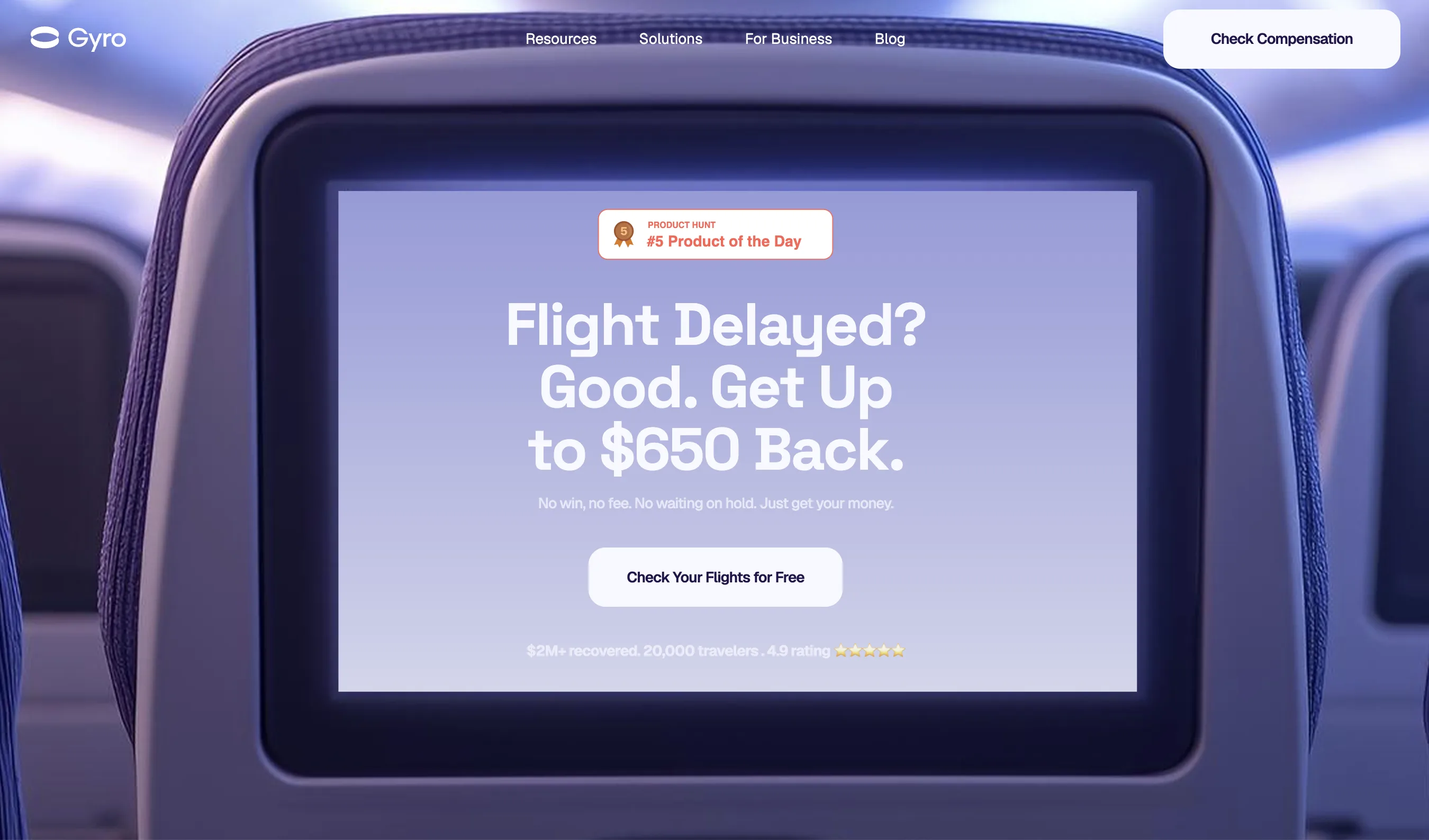
Gyro is the fastest service to get started with, and for most travellers filing a straightforward claim it is the natural first choice. Built as an AI-native, mobile-first platform, the intake process takes minutes rather than the form-heavy workflows of older services. Litigation costs are included in some cases, which removes the risk of an unexpected secondary bill.
Strengths
- Fastest onboarding process of any service in this comparison
- AI-native mobile app built for speed — no lengthy paper trails
- Efficient UK-focused workflow aligned with UK261
- Litigation included in some cases, reducing bill-shock risk
Trade-offs
- Shorter operating history than established players like AirHelp or Flightright
- Less proven in multi-year or highly complex litigation
Best for: Travellers who want to get a claim moving quickly on a mobile device. If speed and simplicity matter more than legacy scale, Gyro is the strongest choice available.
2. AirHelp: Best for Hands-Off, Large-Scale Claims
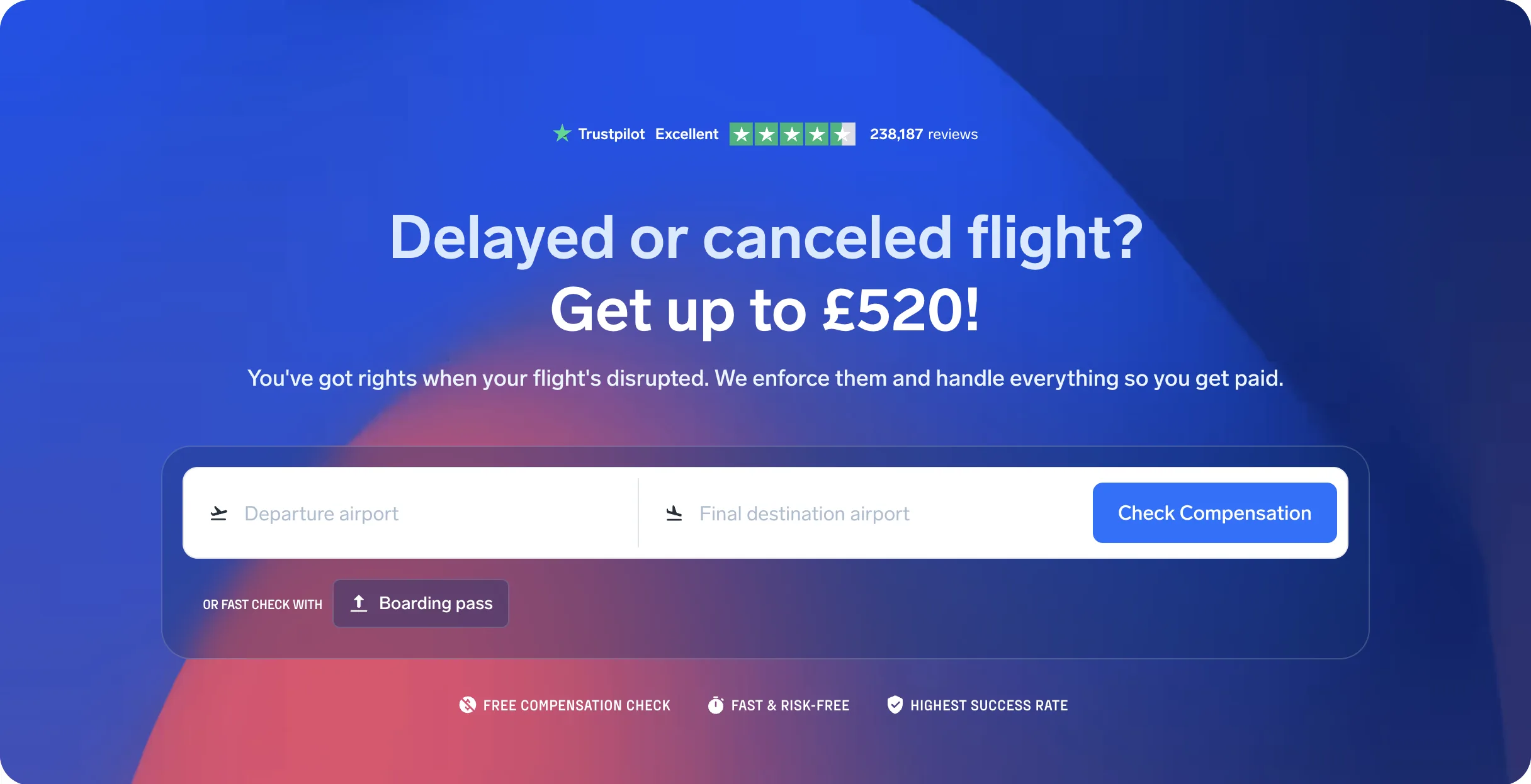
AirHelp is the largest brand in the industry by claim volume. Its inbox-scanning feature automatically identifies disrupted flights from your email history, making it the most genuinely hands-off option available. That convenience comes at a price: the standard fee sits at around 35%, and once litigation is factored in the total cost can approach 50% of the compensation recovered.
Strengths
- Largest operational scale and global coverage of any service in this comparison
- Inbox scanning identifies eligible past flights you may have forgotten about
- Strong automation across the full claims process from submission to payment
Trade-offs
- Standard fee of around 35%, with additional litigation fees possible on contested cases
- Combined fees can reach approximately 50% in court-stage disputes
- Less personalised support than smaller services
Best for: Travellers who want maximum automation and are comfortable paying a premium for it. Also worth considering if you want to scan past flights systematically — the inbox feature can surface claims you never knew you had.
3. Flightright: Best for Disputed or Rejected Claims
Flightright takes a litigation-first approach. If an airline has already denied your claim — particularly by citing extraordinary circumstances — Flightright is the most aggressive enforcer in this comparison. It consistently takes airlines to court when other services have accepted a denial and moved on.
Strengths
- Exceptional track record in contested claims and court-stage enforcement
- Does not accept airlines’ initial denials at face value
- Strong expertise in German and broader DACH aviation markets
Trade-offs
- Slower for simple cases due to its legal-first workflow
- More process-heavy than services designed for quick, low-friction claims
Best for: Anyone whose claim has already been rejected. If the airline cited weather or extraordinary circumstances and you have reason to believe the actual cause was operational — a technical fault, crew shortage, or scheduling issue — Flightright is the right escalation path.
4. Compensair: Best Low-Fee Option
Compensair charges around 25%, placing it among the lowest standard fees available. Its online portal is clean and efficient. For a standard delay on a direct EU route where the airline has not yet responded, Compensair delivers strong value without the overhead of larger platforms.
The trade-off is reach. Compensair has a smaller global footprint than AirHelp and less litigation depth than Flightright. For uncomplicated claims within the EU, it is one of the best cost-to-outcome options in this comparison.
5. AirAdvisor: Best for International Routes
AirAdvisor positions itself as a transparent platform built for international complexity. It handles claims that fall under multiple regulatory frameworks — not just EU261 and UK261 — and invests more in consumer education than most competitors. Its fee structure is disclosed clearly upfront.
Scale is the trade-off. AirAdvisor is smaller than AirHelp, and resolution timelines can vary depending on the airline and jurisdiction. For international routes where a single regulation may not cover the full claim, it is the strongest specialist available.
Other Services Worth Knowing
SkyRefund — Strong Trustpilot reputation and a litigation fee that is often included in its standard 35% commission. A solid all-round choice for EU and UK claims.
MyFlyRight — Charges around 25% with a multilingual interface. Well-suited to German-speaking travellers and DACH routes.
ClaimFlights — Also around 25%, with litigation often included. Good multi-language coverage for European routes.
Refundmore — The strongest specialist for Scandinavian routes. If your disruption involved SAS, Norwegian, or a Nordic low-cost carrier, Refundmore’s regional expertise is a meaningful practical advantage.
ClaimCompass — Around 35% with a streamlined process for uncomplicated EU261 cases. Better suited to simple claims than litigation-heavy disputes.
Common Mistakes That Kill Compensation Claims
Even valid claims fail. These are the six most common reasons passengers lose compensation they were genuinely owed.
Accepting a voucher too quickly. Airlines routinely offer food credits, travel vouchers, or discount codes immediately after a disruption. Accepting without reading the terms can waive your statutory right to cash compensation under [EU261] or UK261. Read before you sign anything at the gate.
Waiting too long. Claim deadlines vary significantly by country. Some jurisdictions allow six years; others allow as few as two. Travellers with entirely valid claims lose them every year by waiting. File as soon as you have documented the disruption.
Discarding boarding passes. Your booking confirmation proves you bought a ticket. Your boarding pass proves you actually showed up. Keep both — as screenshots or digital files — for any disrupted flight. Booking confirmations alone may not be sufficient evidence.
Taking the first denial at face value. Initial rejections from airlines are frequently automated. Extraordinary circumstances are regularly cited for delays that were operationally caused. One rejection is not the end of the claim. A specialist service can challenge the classification and escalate formally.
Ignoring codeshare complexity. If you booked through Airline A but flew on Airline B’s aircraft, the operating carrier is usually the liable party under EU261 — not the airline that sold you the ticket. Filing against the wrong carrier wastes time and can forfeit the claim.
Assuming award tickets do not qualify. They do. Tickets purchased with miles or points generally still qualify under EU261 and UK261. The statutory compensation amount is calculated on the fare class, not on the points spent. If you used an [expert flight booking service] to redeem your miles, your passenger rights travel with the ticket.
Which Service Should You Use?
| Your situation | Best pick | Why |
|---|---|---|
| You want the fastest, easiest process | Gyro | AI-native app with the quickest intake of any service in this comparison |
| Your claim has already been rejected | Flightright | Litigation-first approach; takes airlines to court when others give up |
| You want the lowest fee | Compensair or MyFlyRight | Both charge around 25%; clean portals; suited to straightforward EU claims |
| You want full automation and minimal effort | AirHelp | Largest scale; inbox scanning detects eligible past flights automatically |
| Your disruption involved an international route | AirAdvisor | Built for cross-border complexity; transparent fee structure |
| Your route was Scandinavian | Refundmore | Specialist in SAS, Norwegian, and Nordic low-cost carriers |
| You want to file for free | File directly | Under EU261/UK261 you can file with the airline at no cost; escalate to the CAA if denied |
Most travellers will do best starting with Gyro for speed and ease of use, or Flightright if an airline has already said no. For genuinely complex cases, codeshares, multiple passengers, older claims, a service with litigation experience is worth the higher commission. When in doubt, file directly first; it costs nothing, and you can always escalate later.
Get Paid Today
Check How Much Your Airline Miles Are Worth


Frequently Asked Questions (FAQs)
Under [EU261] and [UK261], statutory compensation is fixed by flight distance. For flights under 1,500 km the amount is €250 [approximately $270], or £220 under UK261. For flights between 1,500 km and 3,500 km it is €400 [approximately $430], or £350. For flights over 3,500 km it is €600 [approximately $650], or £520. These amounts are per passenger and apply regardless of the ticket price paid.
EU261 and UK261 do not apply to purely domestic US routes. US passenger rights for delays and cancellations are governed by [Department of Transportation rules], which are less prescriptive and do not guarantee fixed cash compensation in the same way. For transatlantic flights departing from an EU or UK airport, EU261 or UK261 can still apply regardless of the airline's nationality.
Straightforward claims resolved directly with airlines take around four to twelve weeks. Claims handled through a service that require legal escalation can take six months to over a year. Flightright and other litigation-first services take longer but achieve results in cases where a simple submission would have been closed as denied.
All reputable services in this comparison operate on a no-win, no-fee basis — you pay nothing if the claim is unsuccessful. When the claim succeeds, the service deducts its commission from the recovered amount and forwards the balance to you. Always confirm the exact fee structure before submitting, including whether litigation costs are charged separately or bundled into the standard commission.
No. EU261 and UK261 give every eligible passenger the right to file a claim directly with the airline at no cost. If the airline ignores or rejects the claim, you can escalate to the relevant national enforcement body — the [Civil Aviation Authority] in the UK, or the national body in the EU country where your departure airport is located. Compensation services exist to manage the process for you and to enforce legally when self-filing has not worked.